Retry Backoff Calculator
API & BackendInstantly compute exponential backoff delays for every retry attempt. Tune your initial delay, multiplier, and cap to build a retry strategy that avoids thundering herd while staying within latency budgets.
Last updated: April 2026
This calculator is designed for real-world usage based on typical engineering scenarios and publicly available documentation.
A retry backoff calculator takes the guesswork out of designing fault-tolerant API clients. Exponential backoff is the standard pattern for retrying failed requests — each attempt waits longer than the last, reducing hammering on an already-stressed upstream service. Without the right parameters, retries can make outages worse. Too short a base delay floods a degraded API with requests; too long a max cap leaves your users waiting indefinitely. This calculator lets you preview every retry delay and the total wait time before you write a single line of code. Backend engineers, platform teams, and API integrators use retry backoff settings when connecting to third-party services, cloud APIs (AWS, GCP, Stripe, Twilio), and internal microservices. Getting these numbers right is the difference between graceful degradation and a cascading failure. The formula below is provider-agnostic. Whether you are configuring axios-retry, tenacity in Python, Polly in .NET, or a custom fetch wrapper in TypeScript, plug your target values in and validate the timing before deploying.
How to Calculate Retry Backoff Delays
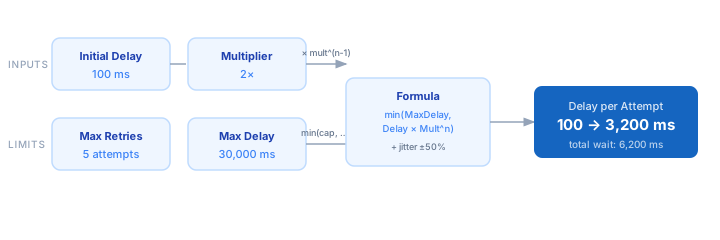
1. Set your initial delay — the wait time in milliseconds before the very first retry (common values: 100 ms, 250 ms, 500 ms). 2. Choose a backoff multiplier — how much each subsequent delay grows (2× is the standard; 1.5× is gentler). 3. Set max retries — how many times your client should attempt the call before giving up (3–5 is typical for API calls). 4. Set a max delay cap — the ceiling for any single retry delay to prevent waits from growing unbounded (5 s–60 s for most APIs). 5. Read the per-attempt delay table above — each row shows the delay for that attempt and cumulative wait so far. 6. Add ±25–50% jitter in your code to randomise delays and avoid thundering herd when many clients retry simultaneously.
Formula
Delay(n) = min(MaxDelay, InitialDelay × Multiplier^(n-1))

InitialDelay — wait before first retry, in milliseconds (e.g. 100 ms)
Multiplier   — growth factor applied each attempt (e.g. 2 for classic doubling)
n            — retry attempt number, starting at 1
MaxDelay     — ceiling cap so delays never grow unbounded (e.g. 30,000 ms)

With jitter (recommended):
Delay(n) = Delay(n) × uniform(0.5, 1.5)   // ±50% random spread
Example Retry Backoff Calculations
Example 1 — Standard 2× doubling (REST API client)
Initial: 200 ms · Multiplier: 2× · Cap: 30,000 ms

Attempt 1:  200 ms
Attempt 2:  400 ms
Attempt 3:  800 ms
Attempt 4:  1,600 ms
Attempt 5:  3,200 ms
              ──────────
Total wait: 6,200 ms (6.2 s across 5 retries)
Example 2 — Conservative 1.5× growth (rate-limited SaaS API)
Initial: 500 ms · Multiplier: 1.5× · Cap: 10,000 ms

Attempt 1:    500 ms
Attempt 2:    750 ms
Attempt 3:  1,125 ms
Attempt 4:  1,688 ms
Attempt 5:  2,531 ms
              ──────────
Total wait: 6,594 ms — gentler pressure on the upstream
Example 3 — Capped backoff hitting the ceiling (high-traffic service)
Initial: 1,000 ms · Multiplier: 3× · Cap: 15,000 ms

Attempt 1:  1,000 ms
Attempt 2:  3,000 ms
Attempt 3:  9,000 ms
Attempt 4: 15,000 ms  ← cap reached
Attempt 5: 15,000 ms  ← cap held
              ──────────
Total wait: 43,000 ms — cap prevents runaway delays after attempt 3
Tips for Building a Reliable Retry Strategy
- › Always add jitter. A ±25–50% random spread prevents all clients retrying at exactly the same millisecond after a shared outage — the thundering herd problem. Use <code>delay × (0.5 + Math.random() * 1.0)</code> in JS.
- › Retry on 429 and 503 only. Retrying 400 Bad Request or 422 Unprocessable Entity wastes retries and quota — these are client errors that will not resolve on their own. Only retry transient server-side and network failures.
- › Honour <code>Retry-After</code> headers. APIs like Stripe, GitHub, and OpenAI return a <code>Retry-After</code> value on 429 responses. Use that value instead of your computed delay — it's the provider's authoritative signal.
- › Set a total timeout budget. Track wall-clock time across all retries and abort once you exceed a deadline (e.g. 30 s). Use the <a href="/calculators/latency-budget-calculator">Latency Budget Calculator</a> to size your total budget before setting max retries.
- › Use idempotency keys for mutating calls. POST requests that create resources can safely retry only when you attach a client-generated idempotency key — without one, each retry may create a duplicate record.
- › Limit retry scope to network-level calls. Don't retry inside deep call stacks — retry at the outermost client boundary so the total retry count stays predictable and observable.
Notes
- › Results are estimates and may vary based on actual usage.
- › Always validate against your production environment.