TLS Handshake Time Estimator
PerformanceEnter your network RTT and TLS version to instantly estimate HTTPS handshake overhead. Works for TLS 1.2, TLS 1.3, and 0-RTT session resumption.
Last updated: April 2026
This calculator is designed for real-world usage based on typical engineering scenarios and publicly available documentation.
The TLS handshake time estimator calculates how long your HTTPS connection setup takes before a single byte of application data is transferred. TLS 1.2 requires two full round trips to negotiate cipher suites, exchange certificates, and confirm keys — meaning a 100 ms RTT server adds 200 ms of pure handshake overhead to every new connection. TLS 1.3 cuts this to one RTT, and 0-RTT session resumption eliminates the handshake RTT cost entirely for returning clients. This matters most for APIs serving mobile clients over high-latency networks, microservices making many short-lived connections, and CDN origins receiving frequent cold connections. A single poorly tuned TLS configuration can add hundreds of milliseconds to your perceived latency without touching a line of application code. Use this calculator before and after infrastructure changes to quantify the improvement. Plug in your measured RTT (from ping or traceroute), choose your TLS version multiplier, and add any OCSP validation overhead if you are not using OCSP stapling. The result is the raw handshake cost that stacks on top of your DNS lookup and TCP connection time. The formula applies equally to nginx, Caddy, AWS ALB, Cloudflare, and any TLS-terminating proxy — the math is protocol-level, not implementation-specific.
How to Estimate TLS Handshake Time
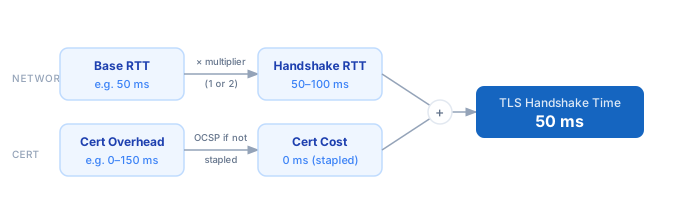
1. Measure your base RTT to the server using ping, traceroute, or browser DevTools network waterfall. 2. Identify your TLS version: TLS 1.3 costs 1 × RTT, TLS 1.2 costs 2 × RTT, 0-RTT session resumption costs 0 × RTT. 3. Check whether OCSP stapling is enabled on your server. If not, add 50–150 ms for OCSP responder round trip. 4. Enter RTT, multiplier, and certificate overhead into the calculator above. 5. The result is your baseline TLS handshake overhead — the time before any application data flows.
Formula
TLS Handshake Time = (RTT × TLS Multiplier) + Certificate Overhead

RTT                  — base network round-trip time in milliseconds
TLS Multiplier       — 2 for TLS 1.2 · 1 for TLS 1.3 · 0 for 0-RTT resumption
Certificate Overhead — OCSP/CRL validation delay in ms (0 if OCSP stapling is enabled)
Example TLS Handshake Time Calculations
Example 1 — TLS 1.3 with OCSP stapling (optimal)
RTT: 30 ms  ×  TLS 1.3 multiplier (1)  =  30 ms handshake RTT
Cert overhead: 0 ms (OCSP stapling enabled)
                                                ─────────────────────
Total TLS handshake time: 30 ms
→ Best-case scenario: modern TLS version + stapling eliminates cert overhead.
Example 2 — TLS 1.2 without OCSP stapling (common default)
RTT: 50 ms  ×  TLS 1.2 multiplier (2)  =  100 ms handshake RTT
Cert overhead: 100 ms (OCSP round trip to CA responder)
                                                ─────────────────────
Total TLS handshake time: 200 ms
→ Upgrade to TLS 1.3 + stapling to cut this to ~50 ms.
Example 3 — TLS 1.2 cross-region API (high-latency path)
RTT: 150 ms  ×  TLS 1.2 multiplier (2)  =  300 ms handshake RTT
Cert overhead: 80 ms (partial OCSP caching)
                                                ─────────────────────
Total TLS handshake time: 380 ms
→ Migrate to TLS 1.3 to save 150 ms; enable session tickets to allow 0-RTT resumption on subsequent calls.
Tips to Reduce TLS Handshake Time
- › Enable TLS 1.3 on your server. It cuts handshake RTTs from 2 to 1, saving one full network round trip on every new connection — often 30–200 ms depending on geography.
- › Enable OCSP stapling. Without it, the client must separately contact the CA's OCSP responder to validate your certificate, adding 50–150 ms to every handshake.
- › Use TLS session tickets or session IDs to allow 0-RTT resumption for returning clients, bypassing the handshake entirely on repeat visits.
- › Terminate TLS close to your users. Move TLS termination to a CDN edge or regional PoP to reduce base RTT — the biggest lever on handshake time is raw network distance.
- › Prefer ECDSA certificates over RSA. ECDSA keys are smaller, reducing the certificate payload transmitted during the handshake and cutting parsing overhead.
- › Use HTTP/2 or HTTP/3 (QUIC). Both multiplex requests over a single TLS connection, amortizing handshake cost across many requests rather than paying it per call.
Notes
- › Results are estimates and may vary based on actual usage.
- › Always validate against your production environment.
Frequently Asked Questions
What is a TLS handshake and why does it add latency? +
How many round trips does TLS 1.2 vs TLS 1.3 require? +
What is OCSP stapling and how does it affect handshake time? +
How do I measure actual TLS handshake time in production? +
curl -w "%{time_connect} %{time_appconnect}" to see TCP connect and TLS handshake times separately. Browser DevTools Network tab shows "SSL" timing in the connection waterfall. For ongoing monitoring, server-side metrics from nginx ($ssl_handshake_time) or OpenTelemetry TLS instrumentation give per-request data. Subtract TCP connect time from TLS connect time to isolate the handshake cost.