HTTP Request Size Calculator
API & BackendEstimate the total byte size of any HTTP request — method, URL, headers, and body combined. Built for developers debugging gateway limits, API quotas, and network bandwidth.
Last updated: April 2026
This calculator is designed for real-world usage based on typical engineering scenarios and publicly available documentation.
The HTTP request size calculator helps you measure exactly how many bytes an HTTP request consumes before it ever leaves your application. Every HTTP request has four cost-bearing parts: the request line (method + URL + protocol version), the header block, a mandatory blank line, and the optional body. Most developers think only about the body, but headers from authentication tokens, tracing IDs, and content negotiation routinely add 400–1,200 bytes per request. Understanding request size matters whenever you hit API gateway payload limits (AWS API Gateway caps requests at 10 MB), CDN size restrictions, load balancer timeouts triggered by large payloads, or mobile network constraints where every kilobyte of overhead affects latency and cost at scale. Use this calculator when you are debugging a 413 Payload Too Large error, estimating bandwidth costs for high-volume API calls, optimising a microservice that sends millions of requests per day, or validating that your serialised request fits within a messaging system's frame size. Pair it with the Payload Size Calculator to compare JSON vs MessagePack vs Protobuf body sizes before committing to a wire format. The formula applies to HTTP/1.1 requests. HTTP/2 uses HPACK header compression, which can reduce the header portion by 50–90% on repeated requests — but the uncompressed byte count calculated here is the right baseline for capacity planning.
How to Calculate HTTP Request Size
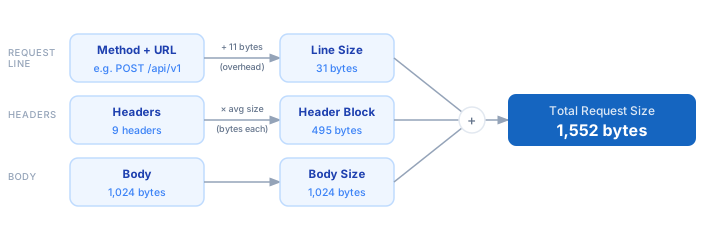
1. Determine the HTTP method ("POST" = 4 bytes, "GET" = 3 bytes, "DELETE" = 6 bytes). 2. Measure the URL length — count every character in the path and query string. 3. Count the number of request headers your client sends (use browser DevTools or a proxy). 4. Estimate the average header line size in bytes — a typical Authorization header with a JWT is 250–500 bytes alone. 5. Enter the body size in bytes — 0 for GET/HEAD, or the serialised body for POST/PUT/PATCH. 6. The calculator adds a request line overhead (method + URL + " HTTP/1.1\r\n" = +10 bytes) and a mandatory blank CRLF line (+2 bytes) to give the full wire size.
Formula
Total Size = Request Line + Headers + Blank Line + Body

Request Line  = method_bytes + 1 (space) + url_bytes + 10 ("HTTP/1.1\r\n" + space)
Headers       = number_of_headers × avg_header_line_bytes
Blank Line    = 2 bytes (CRLF separator between headers and body)
Body          = serialised payload bytes (0 for GET)

method_bytes      — byte length of the HTTP verb (GET=3, POST=4, DELETE=6)
url_bytes         — byte length of the full URL path + query string
number_of_headers — count of distinct header lines sent
avg_header_bytes  — mean bytes per header line including name, colon, value, CRLF
Example HTTP Request Size Calculations
Example 1 — Minimal GET request
Method:  GET (3 bytes)
URL:     /api/users?page=1 (20 bytes)
Headers: 5 headers × 38 bytes avg = 190 bytes
Body:    0 bytes
──────────────────────────────────────
Request line: 3 + 1 + 20 + 10 = 34 bytes
Total: 34 + 190 + 2 + 0 = 226 bytes  (0.22 KB)
Example 2 — Authenticated POST with JSON body
Method:  POST (4 bytes)
URL:     /api/v1/events (16 bytes)
Headers: 9 headers × 55 bytes avg = 495 bytes
         (includes Authorization: Bearer <jwt> ≈ 300 bytes)
Body:    1,024 bytes (JSON payload)
──────────────────────────────────────
Request line: 4 + 1 + 16 + 10 = 31 bytes
Total: 31 + 495 + 2 + 1024 = 1,552 bytes  (1.52 KB)
Example 3 — Large bulk upload near gateway limit
Method:  POST (4 bytes)
URL:     /api/v2/bulk-ingest (22 bytes)
Headers: 12 headers × 60 bytes avg = 720 bytes
Body:    9,437,184 bytes (9 MB JSON array)
──────────────────────────────────────
Request line: 4 + 1 + 22 + 10 = 37 bytes
Total: 37 + 720 + 2 + 9,437,184 = 9,437,943 bytes  (9.00 MB)
→ Within AWS API Gateway's 10 MB hard limit by ~1 MB
Tips to Reduce HTTP Request Size
- › Audit your headers with browser DevTools (Network tab → Headers). Long JWT tokens, verbose tracing headers, and redundant content-negotiation fields are common bloat sources.
- › Use HTTP/2 wherever possible — HPACK compression eliminates repeated header bytes across requests on the same connection, reducing header overhead by 50–90% after the first call.
- › Compress request bodies with gzip or Brotli for large payloads. Most HTTP clients and servers support Content-Encoding: gzip, and a 10 KB JSON body typically compresses to 1–2 KB.
- › Switch to a binary serialisation format (MessagePack, Protobuf, CBOR) for high-volume internal APIs. Protobuf bodies are typically 30–60% smaller than equivalent JSON. Use the <a href="/calculators/payload-size-calculator">Payload Size Calculator</a> to compare formats.
- › Shorten query strings by using short parameter names or POST bodies for complex filters. Every extra character in the URL adds to the request line cost on every single call.
- › Monitor per-request byte costs at scale: at 1M requests/day, trimming 500 bytes per request saves 500 MB of inbound traffic — which matters for load balancer data processing fees.
Notes
- › Results are estimates and may vary based on actual usage.
- › Always validate against your production environment.